


DeReset The pragmatic reset.

A DeReset guide by Hollis

Why One Missed Day Turns Into Three Weeks

The Restart Rule — A Simple System for Getting Back on Track the Next Day

For anyone who starts strong, slips once, and then waits for Monday to try again.

Get the Restart Rule ($27)

30-day money-back guarantee · Instant digital download

A hand pouring coffee into a mug on a sunlit kitchen counter, with a small card propped beside it

You know how this goes.

You decide this is the week. New routine, clear plan, maybe a fresh notebook or a new app. And for a few days it works. You're up on time. You're doing the thing. You feel like someone who finally has it together.

Then an ordinary day shows up. You're tired, or busy, or you just don't feel like it. You skip once.

The next morning you think, well, I already missed yesterday. By the weekend the whole plan feels ruined. And somewhere in there, without ever really deciding to, you stop.

A few weeks later you're back at the start, promising yourself that next Monday will be different.

A desk planner showing the days of the week, with Monday circled in plum ink

The missed day is rarely what hurts. What hurts is the story you tell yourself afterward.

Maybe I just don't have any discipline. Other people stick to things. Why can't I?

So you go looking for more self-discipline. You read the books about mental toughness. You watch the videos that make you feel ready to run through a wall, for about a day. You download a habit tracker and guard your streak like it's precious, right up until it breaks. Then the app goes quiet, and so do you.

None of that was wasted effort. But every one of those attempts aims at the same target: never missing. And you will miss. Everybody does. When the whole plan depends on a perfect run, the first bad day takes the plan down with it.

Here's the shift that changes things.

Plan the day after a miss before the miss ever happens.

Most plans are written for good days. They assume you'll have the time, the energy and the mood. On a bad day the plan has nothing to say, so you fill the silence with "I blew it."

There's also a very human habit working against you. Researchers call it the fresh-start effect: we're more likely to begin again at landmarks like a Monday, a new month or a new year. That pull is useful when you're starting something. After a slip it becomes a trap, because it turns one missed day into days or weeks of waiting for the "right" moment.

So the pattern you keep falling into isn't proof of a weak character. It's a design problem. And design problems can be fixed.

The Restart Rule

The Restart Rule is a four-part setup you build around one thing you've chosen to do. It assumes your willpower will run out sometimes, and it plans for that from day one.

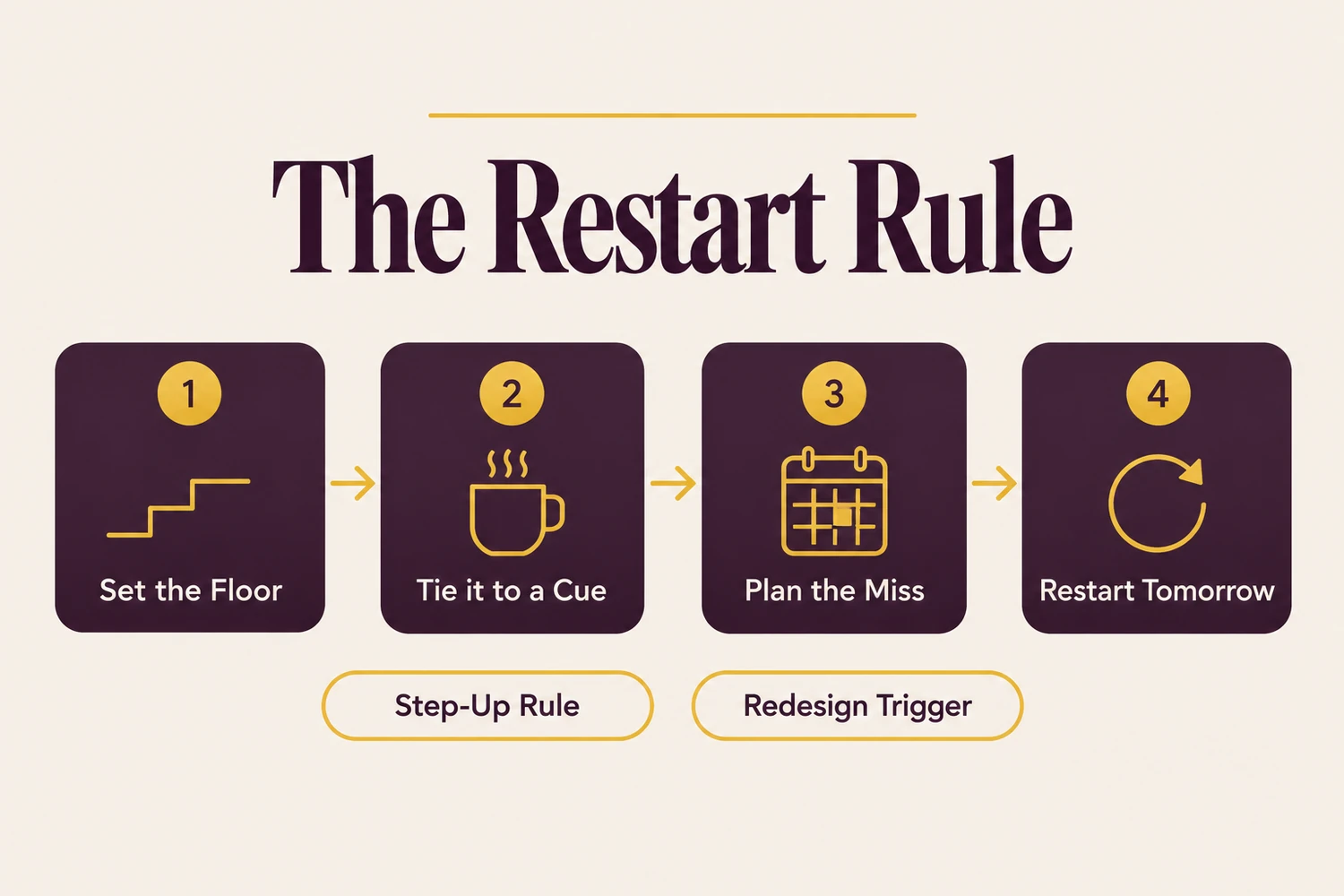
The Restart Rule in four steps: 1 Set the Floor, 2 Tie it to a Cue, 3 Plan the Miss, 4 Restart Tomorrow, with two guardrails: Step-Up Rule and Redesign Trigger
  1. 1

    Set the Floor. Every commitment gets two versions: the full one for good days, and a floor so small it still counts on a bad one. Five minutes. One page. One line of code.

  2. 2

    Tie it to a Cue. Attach it to something you already do every day, like pouring your morning coffee, so you're not deciding from scratch each time.

  3. 3

    Plan the Miss. Decide now what the day after a miss looks like: the floor version, at the same cue, with no penalty and nothing to catch up on.

  4. 4

    Restart Tomorrow. No waiting for Monday. The day after a miss is your fresh start.

Two guardrails keep it honest. If you find yourself living on the floor for a couple of weeks, the rule nudges you back up to the full version, so the floor doesn't quietly turn into your ceiling. And if your misses keep landing in the same spot, you change the setup (a different cue, a smaller floor, a better time) instead of trying harder.

What it looks like on an ordinary Thursday.

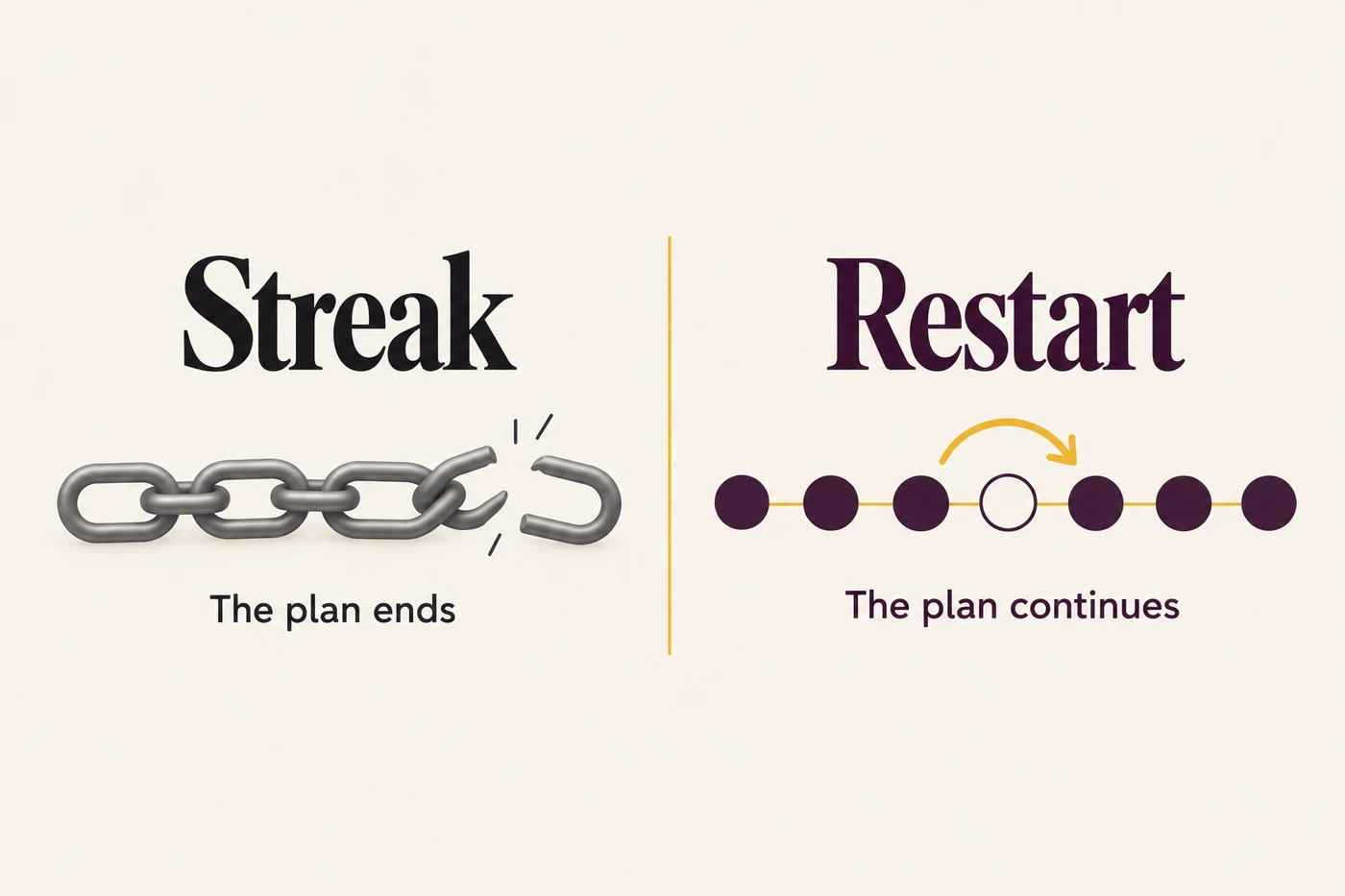
You skipped yesterday. The old you would already be planning Monday's fresh start. Instead, you pour your coffee, glance at the card on the counter, and do the floor version. A few minutes, done. A streak app would call yesterday a failure. The Restart Rule calls today a restart, and today counts.

Side-by-side comparison: a streak shown as a broken chain labeled The plan ends, and a restart shown as a line of dots with one missed dot and an arrow carrying on, labeled The plan continues

You stop counting streaks and start watching your Restart Gap: how many days it takes you to come back after a miss. When that number gets smaller, you're getting better at the part that actually matters.

What's inside

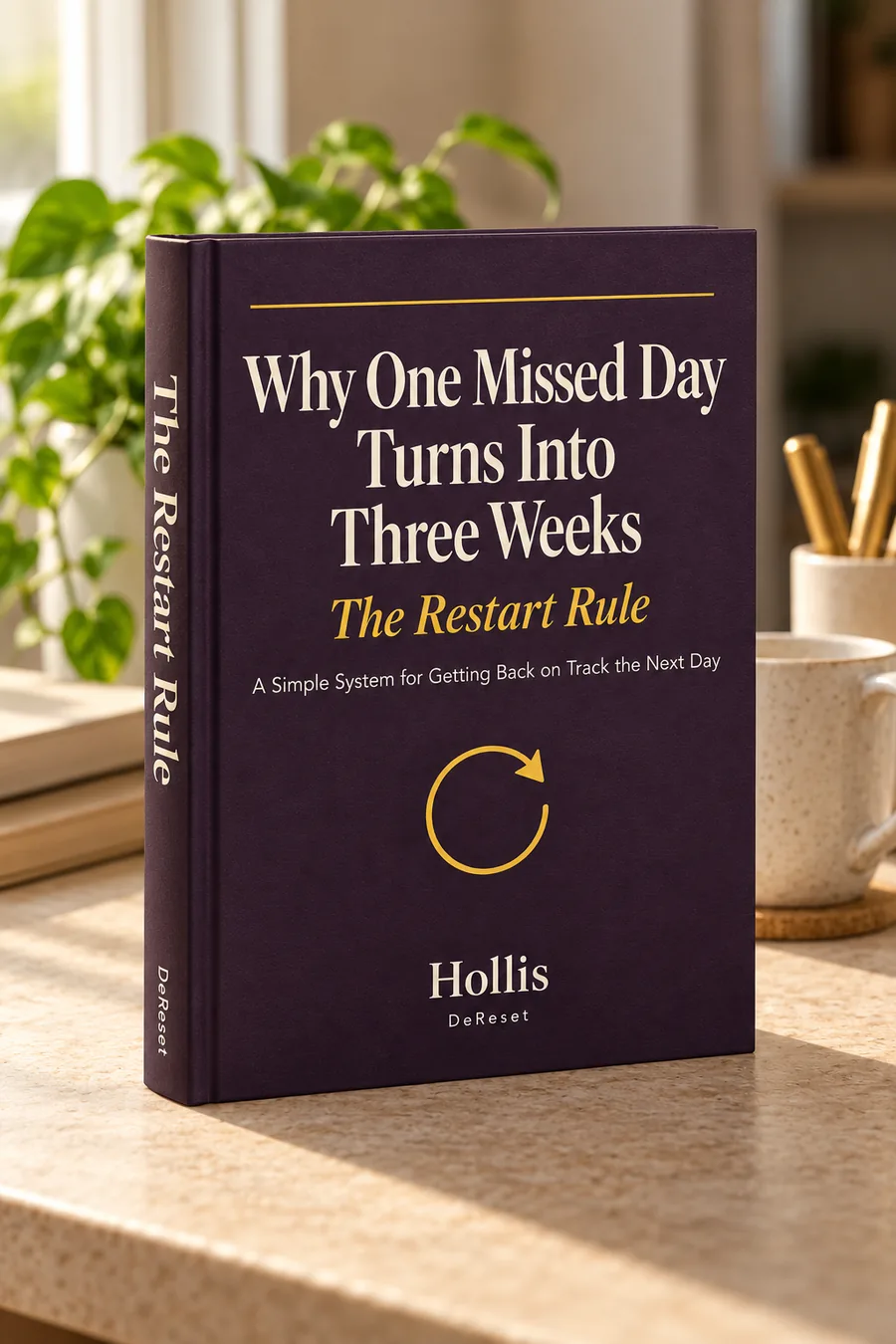
The Restart Rule guide by Hollis, shown as a plum hardcover book on a kitchen counter

The Restart Rule guide. The full method, step by step, with examples drawn from the kinds of things people actually try to stick with: a morning routine, a side project, studying, practicing something new.

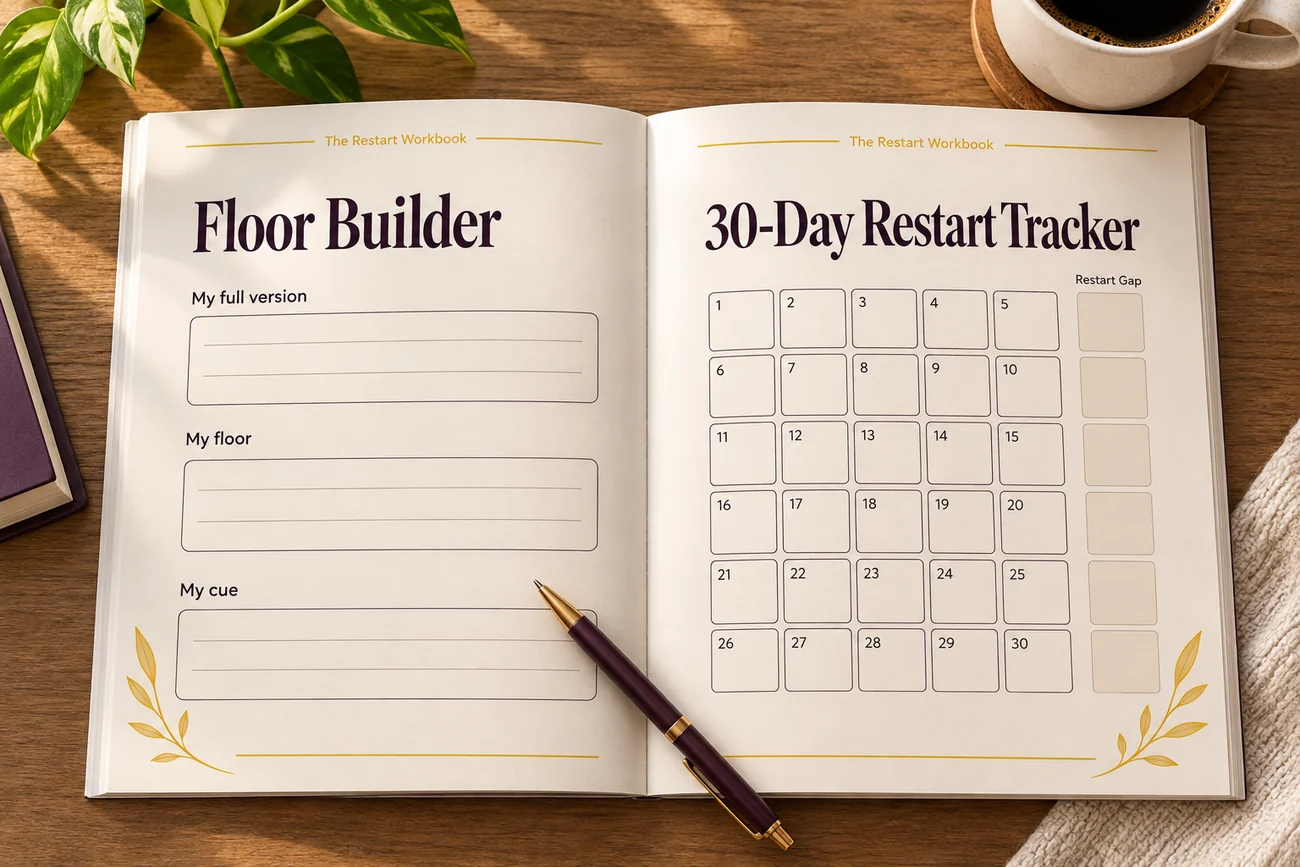
An open spread of The Restart Workbook showing the Floor Builder and the 30-Day Restart Tracker with a Restart Gap column

The Restart Workbook

The Audit, Floor Builder and Tracker come together in one guided workbook, with a short how-to and a worked example for each. The guide tells you why and how; the workbook is where you actually do it.

  • The Follow-Through Audit (your first step). Look back at the last few things you started and dropped, and mark exactly where and how each one slipped. It's built to be done within your first 48 hours, and it turns a vague "I always quit" into something specific you can work with.

  • The Floor Builder. A worksheet for writing your full version, your floor version and your cue in one sentence each.

  • The 30-Day Restart Tracker. Tracks restarts instead of streaks, with your Restart Gap front and center, plus a five-minute weekly review that tells you when to step up and when to change the setup.

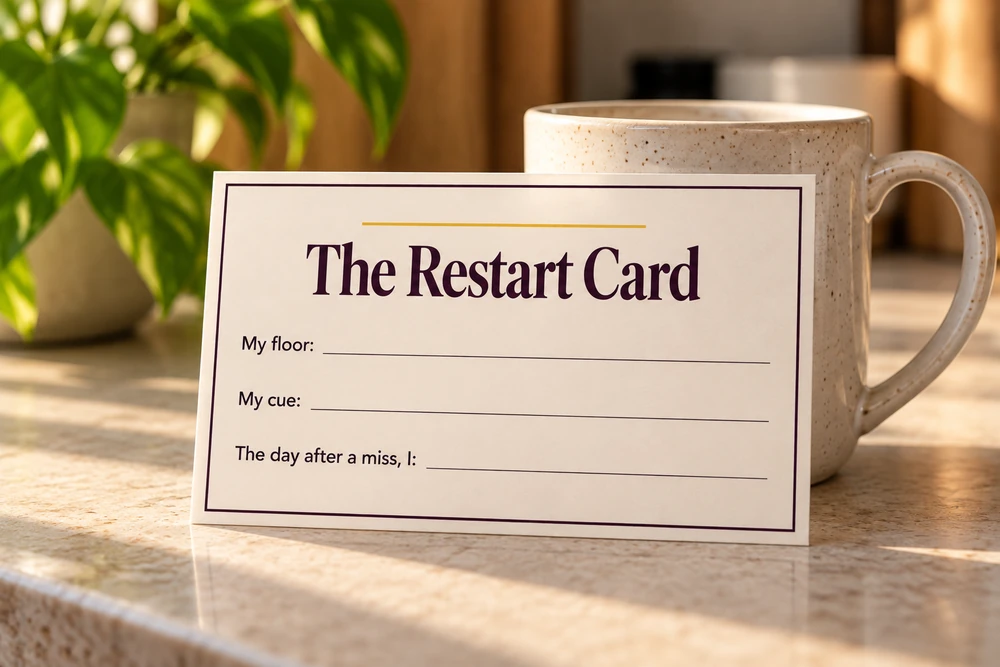
The Restart Card standing on a counter beside a mug, with blank lines for My floor, My cue and The day after a miss, I

The Restart Card. A separate one-page card with your Miss Plan already written on it, so on a bad day you don't have to think. You just follow the card.

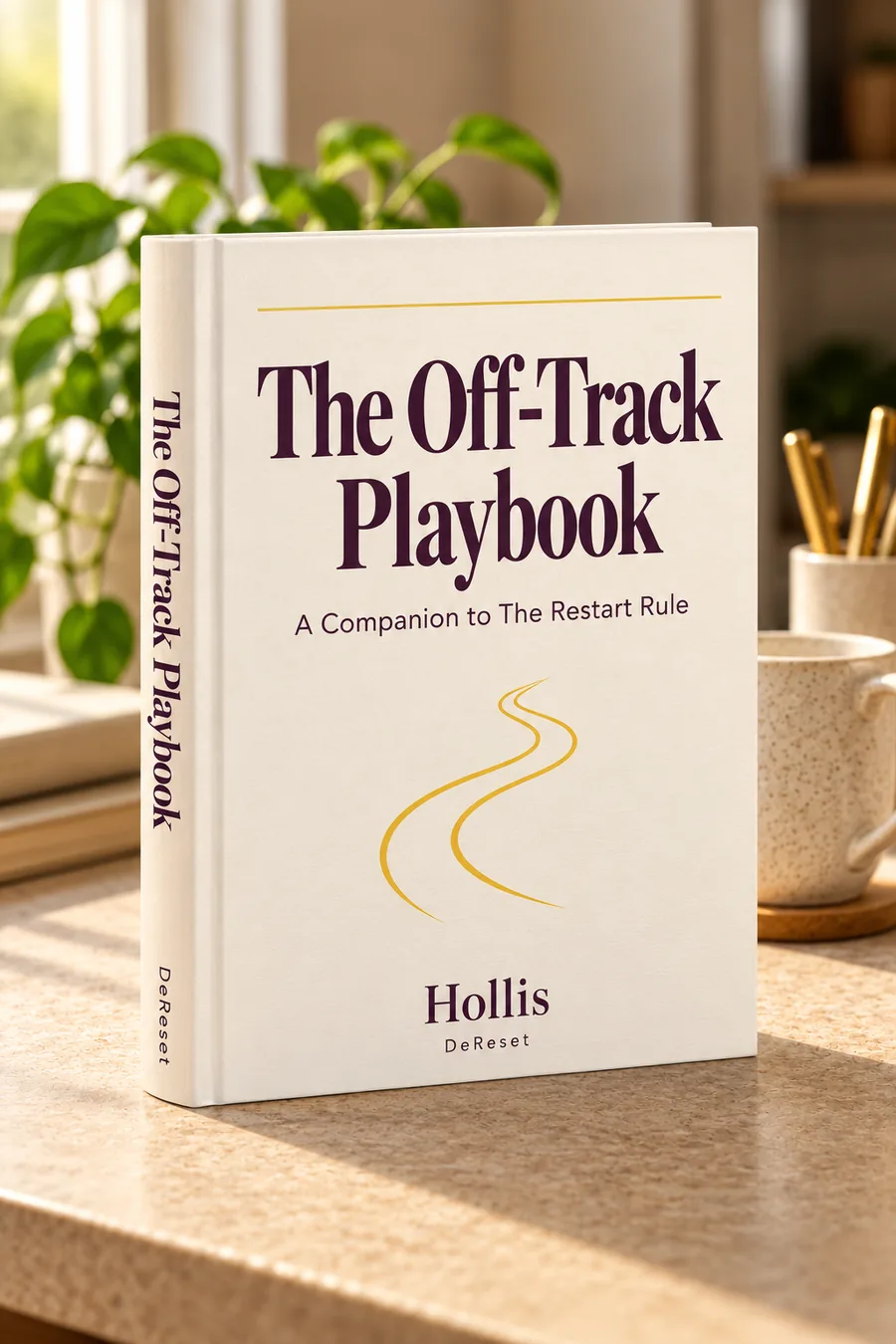
The Off-Track Playbook, a companion to The Restart Rule, shown as a cream hardcover book

Bonus

The Off-Track Playbook

The same Restart Rule, applied to the four situations that tend to knock a routine over completely:

  • The disrupted week: travel, a schedule change, a houseful of visitors
  • The long lapse: coming back after weeks or months away, without shame and without trying to make up for lost time
  • The all-or-nothing spiral: the day one slip makes you want to abandon everything
  • Adding a second commitment: how to take on something new without breaking what's already working
Hollis, the author, sitting at a kitchen table with a mug of coffee
HollisAuthor of The Restart Rule

From Hollis

For years I ran the same loop.

I'd build a big routine, everything at once, and follow it perfectly. Then an ordinary day would come along where I just didn't feel like it, and I'd skip.

That one miss never stayed one miss. By the next morning I'd decided I had already blown it, and a single skipped day turned into three weeks. The streak app went quiet too. Once the chain broke, I stopped opening it.

I told myself what I think a lot of people tell themselves: some people have discipline, and I'm not one of them. So I waited for a cleaner start. Next Monday. The first of the month.

Eventually I noticed the cycle was predictable. It broke the same way every time, right after a miss. That's a design problem, and design problems can be fixed.

So I quit planning for the perfect week and planned for the bad day instead. I assumed my willpower would run out, because it always had.

Every commitment got a floor, something so small it still counted on a rough day. A single rep. One line of code. I tied it to something I already did every day, like pouring my coffee. And I decided ahead of time what the day after a miss looked like: the floor version, same cue, no penalty, nothing to catch up on. The next morning was the restart. Monday could stay Monday.

I stopped counting streaks, too. I started counting how fast I came back.

That's the Restart Rule. A missed day can still happen. The plan is that it stays one day.

I've put the whole setup in this guide so you can build your own. — Hollis
Who this is for

This is for you if there's something you've already decided to do (a routine, a project, a skill, a habit) and you keep starting it, slipping, and starting over. You don't need more motivation. You need a plan for the day after a bad day.

Who it's not for

It's probably not what you're looking for if you're trying to work out which tasks deserve your time at work, or if you want a fitness, diet or money program. The Restart Rule helps you keep doing the things you've already chosen.

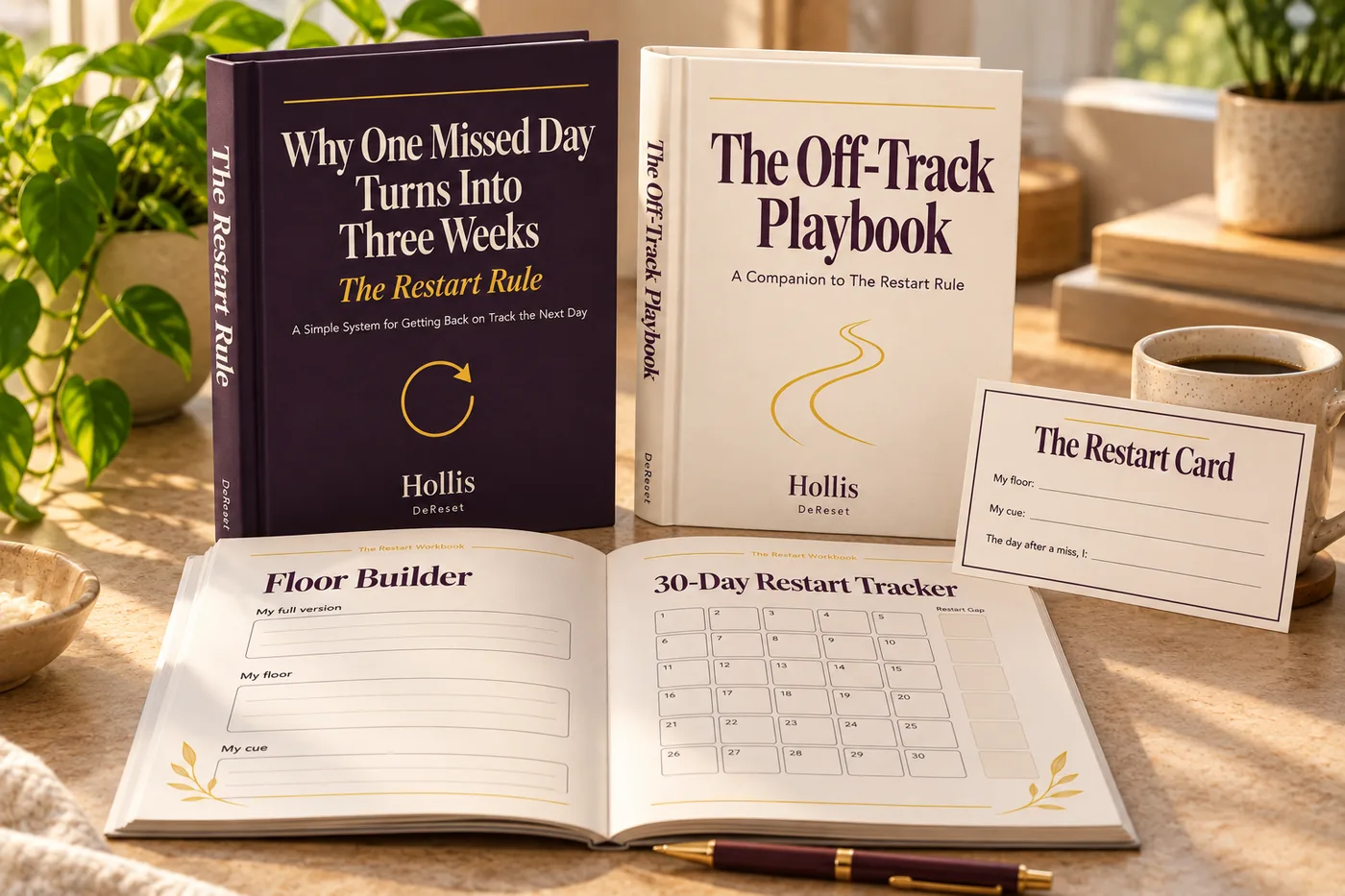
Everything in the bundle: The Restart Rule guide, The Off-Track Playbook, The Restart Workbook open to the Floor Builder and Tracker, and The Restart Card

Everything you get:

  • The Restart Rule guide
  • The Restart Workbook: the Follow-Through Audit, the Floor Builder and the 30-Day Restart Tracker
  • The Restart Card
  • Bonus: The Off-Track Playbook
The guide and tools:$27 value
The Off-Track Playbook:$17 value
Total value:$44

You get everything for $27. One payment, instant digital download.

30-day money-back guarantee seal

30-day money-back guarantee

Try the Restart Rule for 30 days. If it doesn't help you break the start-over cycle, email me at support@dereset.com within 30 days and I'll refund every cent. No hoops.

Questions

I've already read Atomic Habits. Is this the same thing?

Some of it will feel familiar, and that's fine. Tiny starter versions, tying a habit to a cue, not missing twice: good books cover those ideas well. What most of us never do is set them up before the bad day arrives. The Restart Rule gives you a miss plan written down in advance, a card you can reach for, and a way to measure how fast you come back instead of how long your streak lasts.

What if this becomes one more thing I start and drop?

That's exactly the situation it's built for. If you drop it for a day, the rule already tells you what to do the next morning. A missed day is part of the plan here, so it doesn't end the plan.

I don't have a lot of time.

You choose the floor, and it's meant to be small enough for your worst day. Setting everything up is a short, one-time job with the worksheets.

What kinds of goals does this work for?

Things you've chosen to do that nobody else is enforcing: a morning routine, a side project, reading, studying, practicing an instrument, an everyday habit you keep meaning to build. The examples in the guide are illustrations, not programs. It isn't a work task-prioritization system, and it isn't a fitness, diet or financial plan.

Is this for ADHD, depression, or other health issues?

No. This is a practical guide to building habits and getting back on track after a slip. It doesn't diagnose or treat anything. If you're dealing with persistent difficulty that goes beyond everyday habits, it's worth talking to a qualified professional.

How do I get it?

Right after checkout you get instant access to download everything: the guide, the workbook, the card and the bonus.

What if it doesn't work for me?

Then email support@dereset.com within 30 days and you'll get every cent back. No hoops.

There's probably a Monday circled somewhere in your head right now. The day you'll start again, properly this time.

You don't have to wait for it.

Set up the Restart Rule once, and the next time you miss a day (and you will, because everyone does) you'll already know exactly what tomorrow looks like. One missed day. Then a restart. That's the whole idea.

The Restart Rule guide, workbook, card and bonus playbook together on a sunlit counter
Get the Restart Rule ($27)